Fast-Track Concrete Solutions for Commercial and Retail Projects in Baton Rouge
Key Takeaway:
Fast-track concrete in commercial and retail settings is not about cutting corners — it is about sequencing materials, crews, and curing methods to compress timelines without compromising structural integrity. In Baton Rouge, where heat, humidity, and active storm seasons create additional variables, fast-track execution requires both technical precision and experienced local knowledge to deliver results that hold up under heavy commercial use.
Commercial and retail construction operates on timelines that residential projects rarely face. A restaurant renovation that runs two weeks over schedule means two weeks of lost revenue. A retail space delayed past a lease commencement date triggers financial penalties. A parking lot expansion that closes prime spaces during peak season costs more in lost business than the construction itself. In these environments, the ability to execute concrete work quickly, correctly, and without requiring rework is not a bonus — it is a core requirement.
Fast-track concrete solutions address this demand by combining accelerated mix designs, optimized crew scheduling, phased pours, and efficient site management. The goal is to shorten the timeline between groundbreaking and a surface ready for full commercial use.. This guide explains how that process works, what it requires to succeed, and why local conditions in the Baton Rouge area shape how fast-track concrete must be approached differently than it would be in other regions.
What Fast-Track Concrete Actually Means in a Commercial Context
Fast-track concrete is not a single product or technique — it is a project delivery approach that integrates several accelerating strategies simultaneously. For businesses evaluating commercial concrete services in Baton Rouge, understanding what fast-track execution actually involves helps set realistic expectations and ensures that timeline commitments made during the bidding process are grounded in technical reality rather than optimistic estimates.
Accelerated Curing and Mix Design
Standard concrete mixes reach their design strength over 28 days. For commercial projects that cannot wait a month before loading a slab, accelerated mix designs reduce that timeline significantly. Type III cement, which has a finer grind than standard Type I or II, develops strength faster without changing the fundamental chemistry of the concrete. Admixtures — chemical accelerators, calcium chloride in appropriate applications, and high-range water reducers — further compress the strength development curve. In controlled conditions, properly specified accelerated mixes can reach sufficient strength for pedestrian traffic within 24 hours and vehicle loading within 72 to 96 hours.
Phased Pours and Zone Management
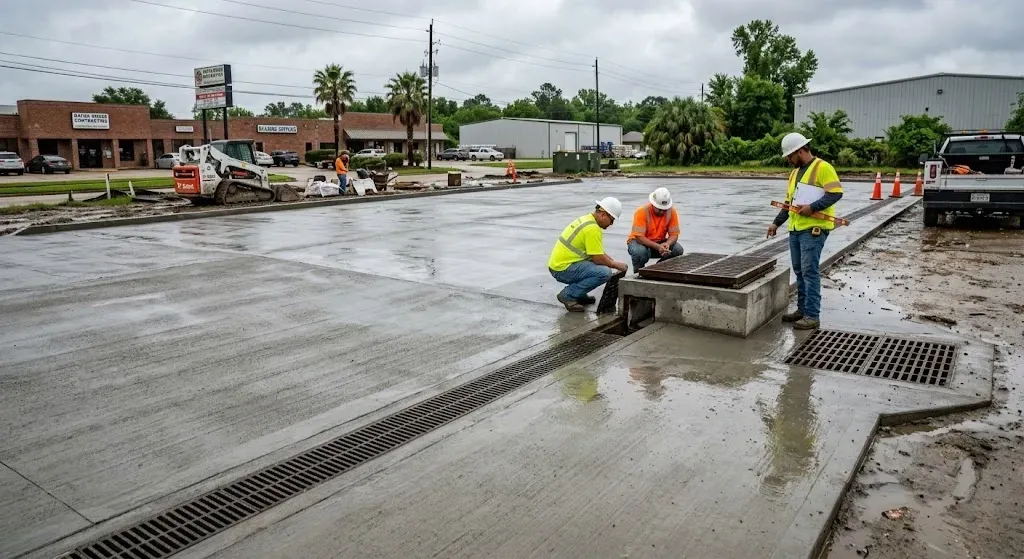
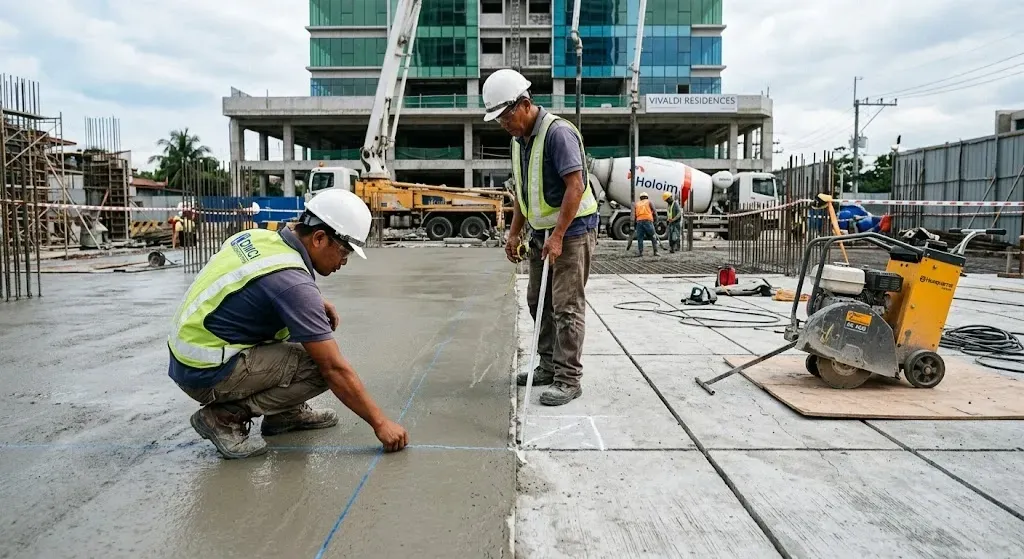
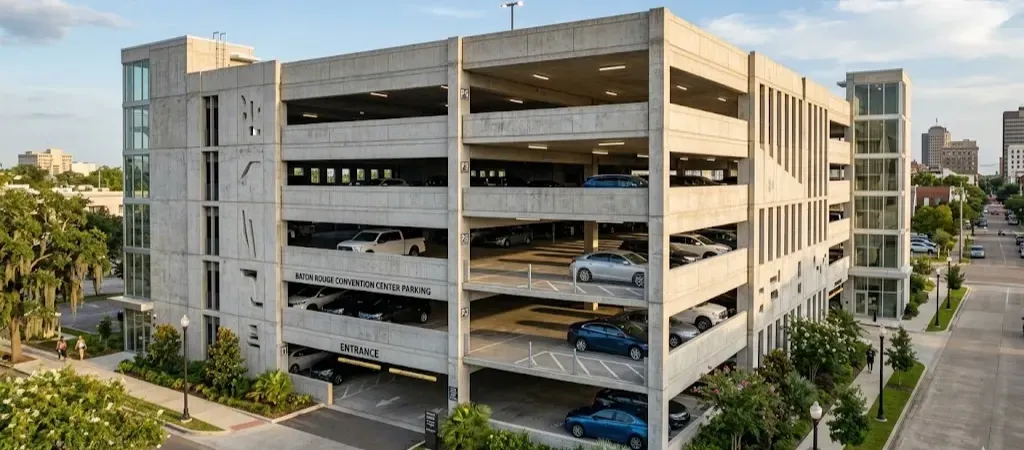
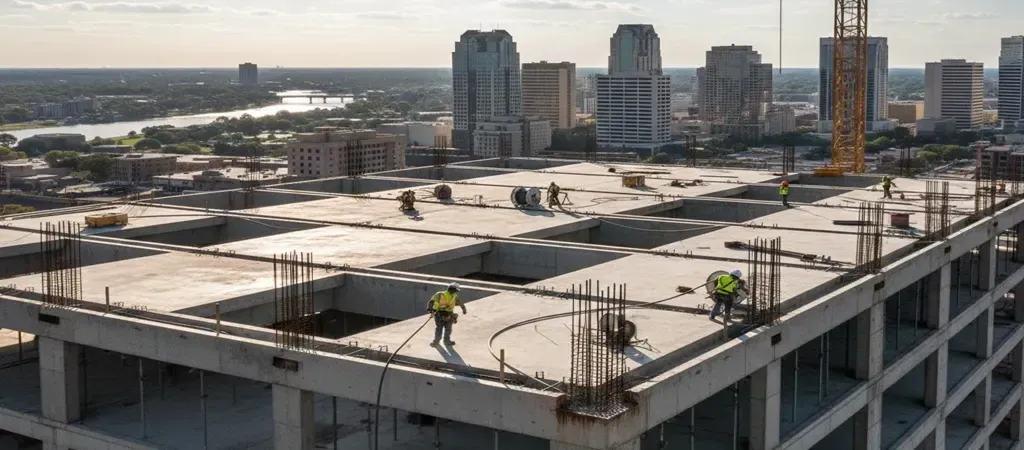
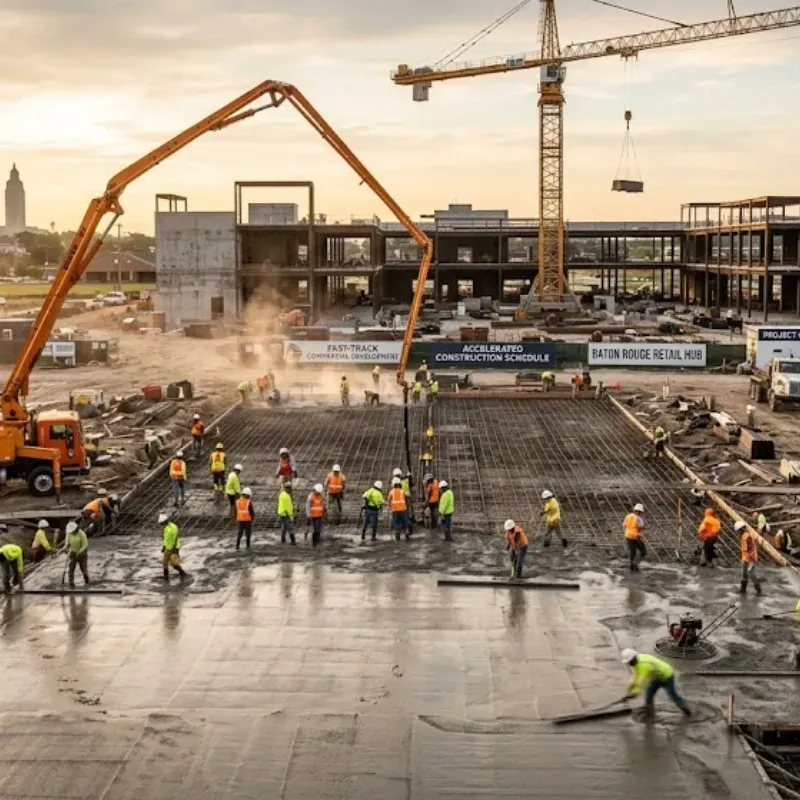
On larger commercial sites such as retail centers, restaurant pads, or parking structures, fast-tracking is also achieved through intelligent zone sequencing. Rather than pouring the entire slab in one operation and waiting for full cure before any work resumes, phased pours allow one area to cure while adjacent zones are being formed, reinforced, and prepared for their own pour. This overlapping schedule requires precise coordination between concrete crews, finishing teams, and other trades but can dramatically reduce the total elapsed time from first pour to full site completion.
Louisiana Climate Factors That Affect Fast-Track Timelines
Baton Rouge’s climate changes fast-track concrete planning in ways that contractors from drier or cooler regions do not always anticipate. High ambient humidity, intense summer heat, and the ever-present possibility of sudden rain events all interact with concrete chemistry in ways that must be managed proactively rather than reactively.
Heat and Evaporation Rate
In summer conditions across the Baton Rouge area, ambient temperatures regularly exceed 90 degrees Fahrenheit, and direct sun can raise slab surface temperatures even higher. High heat accelerates the evaporation of mix water from the surface, which can cause plastic shrinkage cracking before the concrete has developed enough strength to resist it. Fast-track projects in summer require early application of evaporation retarders, shading of freshly placed concrete where feasible, and adjustment of pour timing to cooler morning hours when possible.
Humidity and Curing Efficiency
While high humidity slows evaporation — which is beneficial for surface moisture retention — it also affects the performance of some chemical admixtures and can extend the finishing window in ways that require experienced crew judgment to manage correctly. Wet curing methods, which maintain consistent moisture at the slab surface during the critical early strength development period, remain the most reliable approach in Louisiana's environment despite the additional labor they require.
Storm Window Planning
Baton Rouge receives significant annual rainfall, and afternoon thunderstorms are common throughout the warmer months. Fast-track concrete schedules must build in realistic storm windows and have contingency protocols for rain events that arrive before finishing is complete. Freshly placed concrete exposed to rain before it has set is damaged — the water disrupts the water-cement ratio at the surface and produces a weakened layer that will wear poorly under commercial use. Experienced fast-track crews monitor weather forecasts aggressively and adjust pour timing accordingly.
Scheduling and Crew Coordination as a Fast-Track Tool
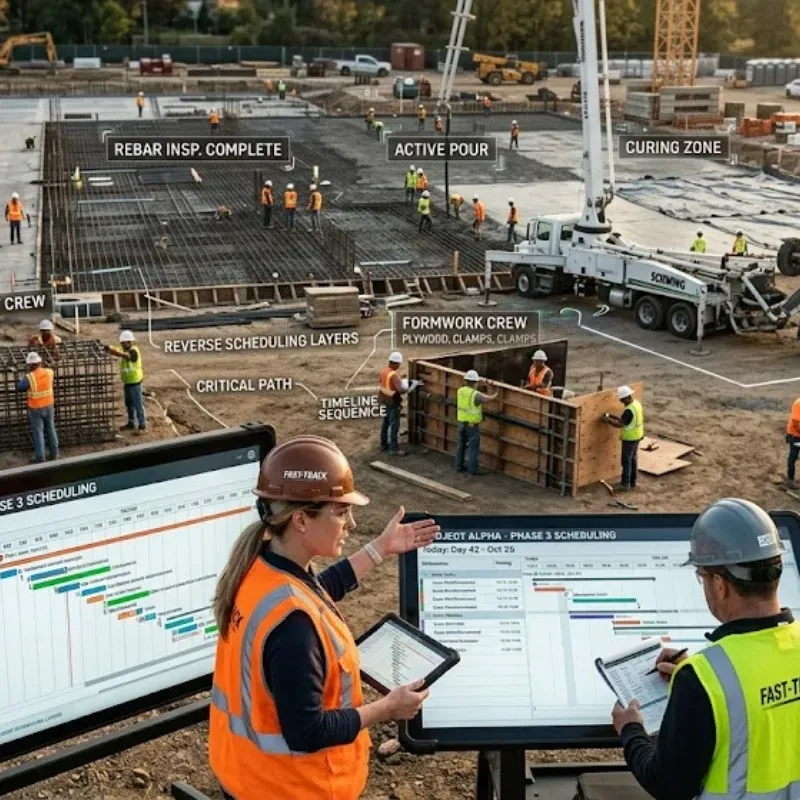
Material selection accounts for part of a fast-track timeline. Crew organization and scheduling discipline account for the rest. Delays on commercial concrete projects are most often caused not by curing time but by coordination failures — the concrete truck arriving before forming is complete, the reinforcement inspection not scheduled in advance, the finishing crew unavailable when the pour reaches that stage.
Effective fast-track execution requires a contractor who treats scheduling as a technical discipline rather than an administrative task.
Baton Rouge Concrete Experts approach commercial timelines by working backward from the required completion date, mapping every phase of the work — subbase preparation, forming, inspection, pour, finishing, curing, and surface preparation — against realistic durations under local conditions. That reverse-scheduled framework is what makes it possible to commit to a commercial deadline with confidence rather than approximation.
Specification Standards for Commercial Fast-Track Pours
Fast-track does not mean reduced specification. Commercial slabs — whether for a restaurant addition, a retail anchor pad, or a drive-through lane — must meet the same structural requirements as conventionally scheduled work. Load capacity, reinforcement, thickness, and surface finish standards do not change because the timeline is compressed.
What changes is the sequencing and the mix design. Reinforcement must be placed and inspected before the accelerated mix arrives on site, because there is less margin for error in the schedule. Subbase compaction must be completed and verified in advance, because the accelerated curing timeline does not allow for remediation of subbase issues discovered after the pour begins.
The specification gap between commercial and residential work is significant and often underestimated by property owners managing their first commercial project. A closer look at commercial vs. residential concrete specifications helps clarify why commercial fast-track work requires a contractor with specific experience in commercial-grade specifications, not simply a residential contractor working at higher volume.
Code Compliance in Compressed Timelines
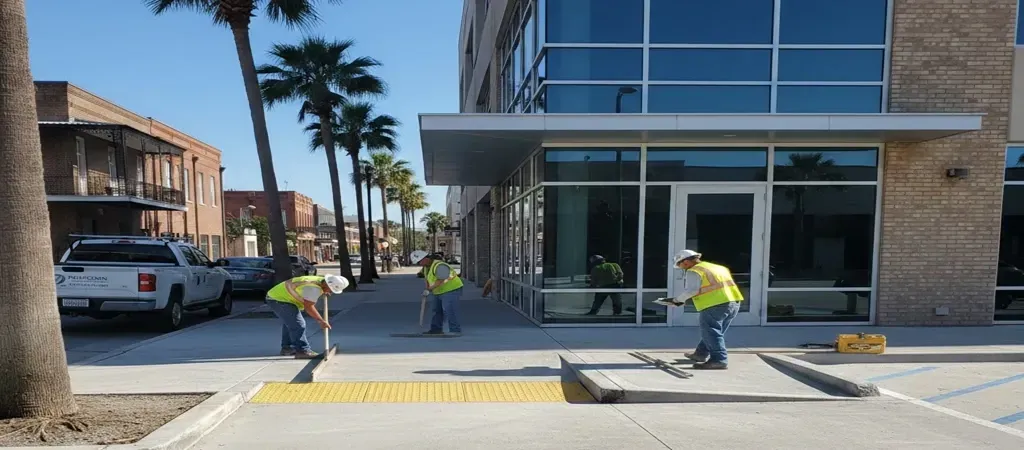
Fast-track commercial concrete projects do not bypass permitting, inspection, or code compliance requirements. In the Baton Rouge area, commercial concrete work must meet City-Parish standards for slab thickness, reinforcement, drainage slope, and in many cases, accessibility requirements that govern surface finish, grade transitions, and ramp geometry.
Accessibility compliance is one area where fast-track projects frequently encounter delays if it is not addressed during the design phase rather than at the end of construction.
Understanding ADA compliance requirements for commercial concrete surfaces before work begins ensures that slope, texture, and transition specifications are built into the forming and finishing plan from the start, eliminating the costly and time-consuming corrections that result from discovering compliance issues after the concrete has cured.
Site Safety Under Fast-Track Conditions
Compressed timelines create pressure that, if not managed carefully, can compromise construction site safety. Accelerated schedules require more workers operating in closer proximity, more material deliveries in shorter windows, and less margin for stopping to address hazards that would be addressed without urgency on a conventional schedule.
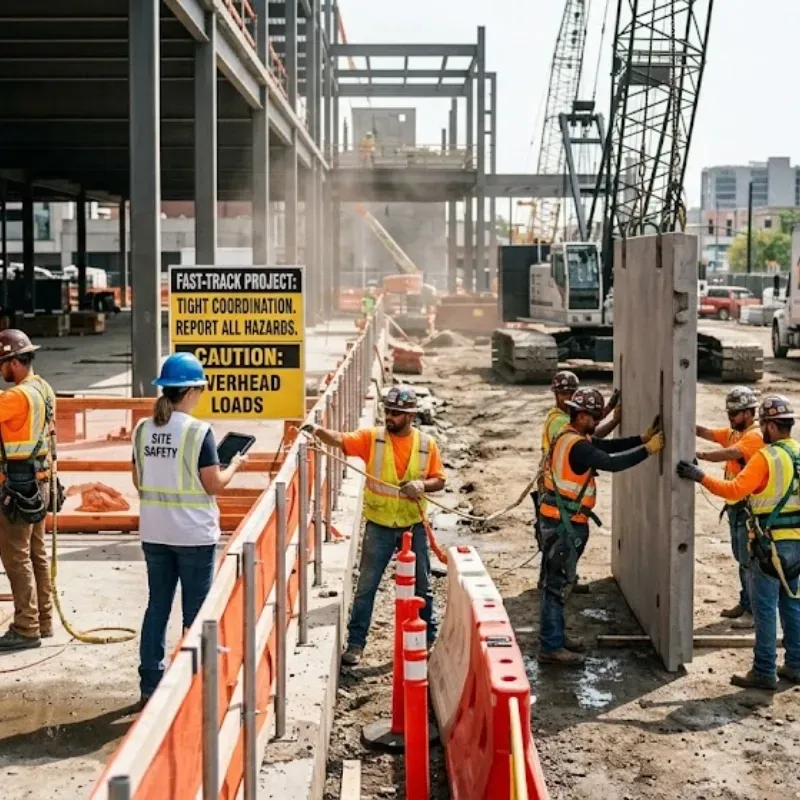
OSHA construction site safety standards do not adjust for fast-track schedules — the same fall protection, personal protective equipment, and excavation safety requirements apply regardless of project pace. Experienced commercial concrete contractors build safety protocols into fast-track scheduling rather than treating them as items to address when time allows. Worksite injuries on an accelerated schedule cause delays that cannot be recovered, in addition to their human cost.
For retail and restaurant clients evaluating contractors, asking how safety is maintained under accelerated scheduling conditions is a reasonable and informative question. That answer reveals whether a contractor's fast-track capability is built on disciplined systems or on the willingness to move quickly without adequate planning.
Speed Without Shortcuts
The value of fast-track concrete in commercial and retail construction is real, but it is conditional on execution quality. A compressed timeline that delivers a structurally sound, code-compliant slab ahead of schedule creates genuine value for a business. A compressed timeline that produces a surface requiring repairs within the first year eliminates that value entirely and adds remediation costs on top.
In Baton Rouge, where climate conditions add complexity to every phase of concrete placement and curing, fast-track success depends on contractors who have worked through those conditions enough times to anticipate problems before they develop rather than respond to them after they occur.
For commercial and retail operators planning concrete work with a tight opening date, the most productive first conversation with a contractor is not about price — it is about the specific sequencing plan, the mix design rationale, the weather contingency protocol, and how inspections will be scheduled within the accelerated timeline. Those details are what separate a realistic fast-track commitment from an optimistic one.