Drainage and Water Management Solutions for Commercial Concrete in Baton Rouge
BOTTOM LINE:
Water is the biggest threat to commercial concrete in Baton Rouge. The city receives heavy rainfall, and without proper drainage built into the concrete from the start, water can move into joints, beneath slabs, and through surfaces, causing damage that worsens over time and becomes expensive to fix.
If you own or manage a commercial property in Baton Rouge, you already know what rain looks like here. Not the occasional drizzle — the kind of sustained, heavy rainfall that floods parking lots, pools against building foundations, and turns unprepared concrete surfaces into maintenance headaches within a few years of installation. Louisiana averages over 60 inches of rain per year, and Baton Rouge sits right in that zone. For commercial concrete such as parking lots, loading docks, warehouse flatwork, retail-center surfaces, and heavy-traffic driveways, drainage design is not a secondary consideration.
This article explains which drainage solutions work for commercial concrete in this environment, why certain approaches matter more in Baton Rouge than they would in drier markets, and what property owners and facilities managers should be asking about before any concrete project breaks ground.
Why Drainage Fails on Commercial Concrete in Louisiana
Most drainage problems in commercial concrete come from one of three sources: inadequate slope, poor joint design, or a subbase that was not prepared to handle the volume of water this climate produces. In Baton Rouge, all three are common — and when you combine any two of them, the deterioration timeline accelerates significantly. For businesses exploring
commercial concrete services in Baton Rouge, drainage design should be one of the first questions on the table, not something that gets figured out after the forms are set.
Inadequate slope is the most straightforward issue. Concrete that does not have enough fall — typically a minimum of one percent grade, or about an inch and a quarter per ten feet — allows water to pond on the surface. Standing water on commercial concrete does several things, none of them good. It accelerates surface wear, works its way into micro-cracks and expansion joints, softens the subbase beneath the slab, and creates slip hazards that represent real liability exposure for property owners.
Joint design is the subtler problem. Expansion and contraction joints are necessary in commercial concrete, but they are also the most vulnerable point for water infiltration if they are not properly sealed and maintained. In Baton Rouge’s humidity and temperature range, joint sealant deteriorates faster than in drier climates, and joints that have been left unsealed or have failed over time become direct pathways for water to reach the subbase. Once water gets under a commercial slab consistently, void formation and settlement follow.
Grading and Surface Slope: Getting the Basics Right
Proper grading starts at the design stage, not after the concrete is poured. A commercial concrete project that begins with thorough site grading — ensuring that the natural drainage path moves water away from structures, loading areas, and high-traffic zones — gives the finished concrete the best possible foundation for long-term performance. In Baton Rouge’s flat topography, achieving adequate slope sometimes requires bringing in fill, cutting into the existing grade, or designing the slab itself with a deliberate cross-slope or crowned profile.
For large commercial parking lots, the standard approach is a crowned center with slopes running toward the perimeter, where catch basins or channel drains collect the water and route it to the storm system. The catch basin placement matters as much as the slope — basins positioned at low points that actually receive the flow rather than at convenient locations that miss the water entirely. Poorly positioned drainage infrastructure is more common than it should be, and it leaves water pooling in the wrong places regardless of how well the surface was sloped.
Channel Drains and Trench Systems
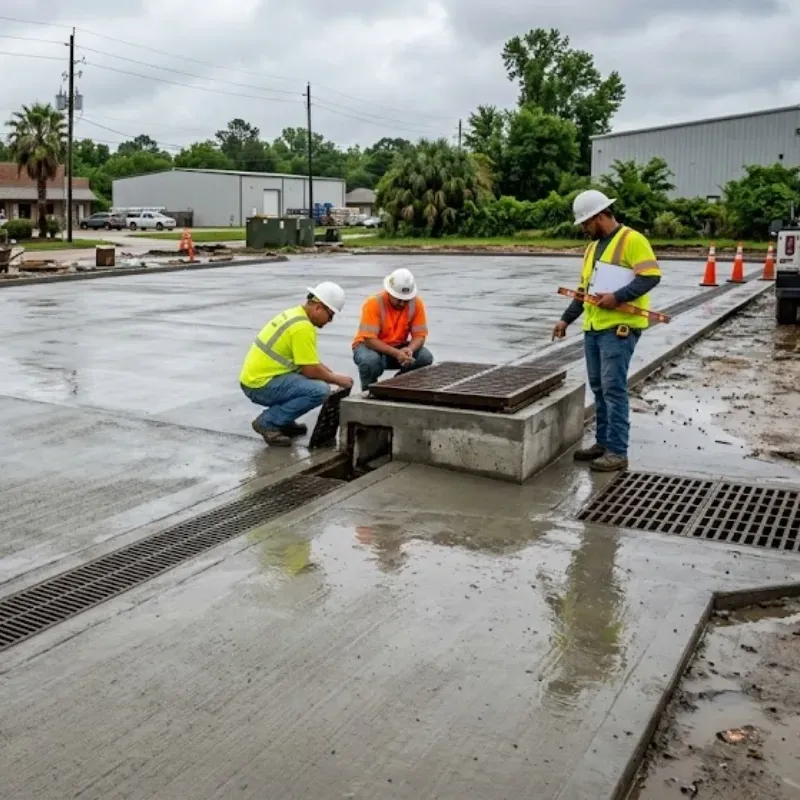
For loading dock areas, drive approaches, and anywhere that water concentration is predictably high, linear channel drains — also called trench drains — are one of the most effective solutions available. A channel drain runs across the width of a driveway or loading area and intercepts water before it can accumulate or flow toward a structure. They are particularly useful at transitions between parking areas and covered loading docks, where water running off a paved surface would otherwise pool against the building.
In commercial applications, channel drain selection matters. Grates need to be rated for the wheel loads they will experience — a standard pedestrian-rated grate will not hold up under repeated forklift or semi-truck traffic. The drain body itself needs to be set at the right elevation relative to the finished concrete surface so it actually intercepts surface flow rather than sitting too high and diverting water around it. These are installation details that make the difference between a drain that works and one that looks like it should work but does not.
Permeable Concrete: A Growing Option for Baton Rouge
Pervious or permeable concrete is an approach that handles stormwater differently than conventional concrete — instead of shedding water off the surface and routing it to a drain, it allows water to infiltrate through the slab itself and into a gravel bed below, where it slowly percolates into the soil. In high-rainfall environments, permeable concrete can reduce runoff volume significantly and is sometimes required or incentivized under local stormwater regulations for larger commercial developments.
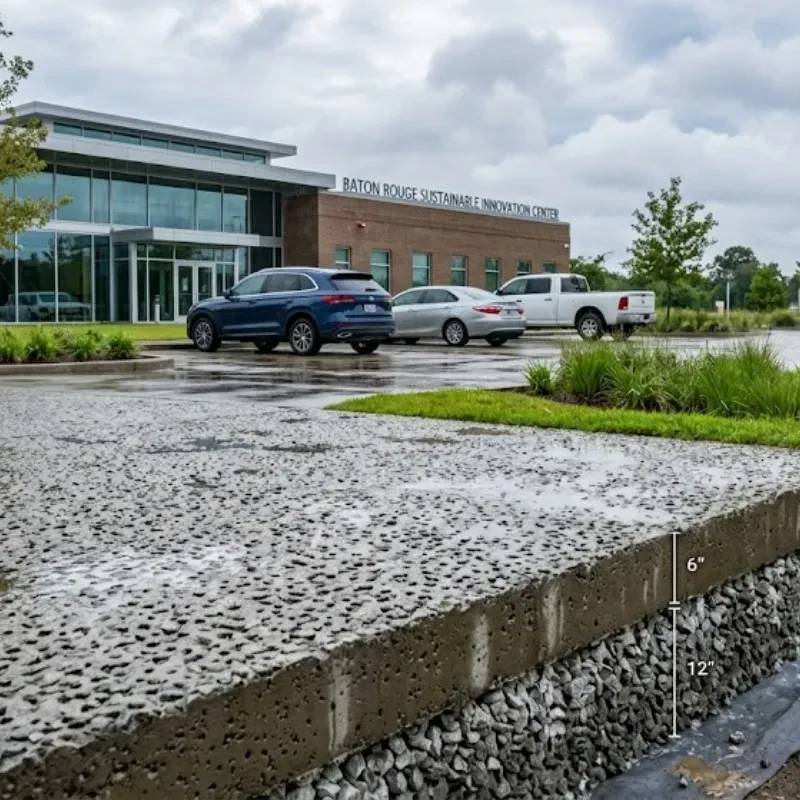
The tradeoff is maintenance. Permeable concrete requires periodic cleaning — typically vacuuming or pressure washing to keep the void structure open — and it is not appropriate for every application. Areas with heavy vehicle traffic, oil or chemical exposure, or fine sediment loading can clog the void structure over time and reduce permeability. At Baton Rouge Concrete Contractors, we assess each site’s conditions before recommending permeable concrete, because it is a strong solution in the right context and a maintenance burden in the wrong one. When it fits, it genuinely performs.
Subbase Preparation: The Foundation of Drainage Performance
Everything above the subbase performs better when the subbase is right. In Baton Rouge’s clay-heavy soils, a properly prepared subbase serves two drainage functions: it provides a stable bearing layer that resists the softening effects of moisture, and in some designs it incorporates a crushed stone layer that allows water that reaches below the slab to drain laterally rather than pooling and creating pressure on the slab from beneath.
The depth and composition of the subbase should be matched to the anticipated load and the site’s specific soil conditions. Heavy vehicle applications — truck courts, loading dock approaches, container storage areas — need more subbase depth and higher compaction standards than standard parking areas. Cutting subbase preparation to save money on a commercial concrete project is one of the most reliable ways to generate a costly repair project within five to ten years.
Joint Sealing and Long-Term Maintenance
Even a perfectly designed and installed commercial concrete project needs ongoing maintenance to perform over its full service life — and in Baton Rouge’s climate, joint sealing is the maintenance item that matters most. Joint sealant prevents water from entering the most vulnerable points in the slab, protects the subbase from saturation, and keeps the concrete performing the way it was designed to.
The standard recommendation is to inspect joint sealant annually and reseal as needed — more frequently in high-traffic areas where sealant degrades faster from wheel loads and surface abrasion. Catching a failed joint seal early costs a fraction of what it costs to repair a slab that has experienced subbase erosion from years of unmanaged water infiltration.
Understanding common concrete issues in Baton Rouge — including the early signs of drainage-related deterioration — helps property managers stay ahead of problems before they require significant remediation.
Planning a Commercial Concrete Project With Drainage in Mind
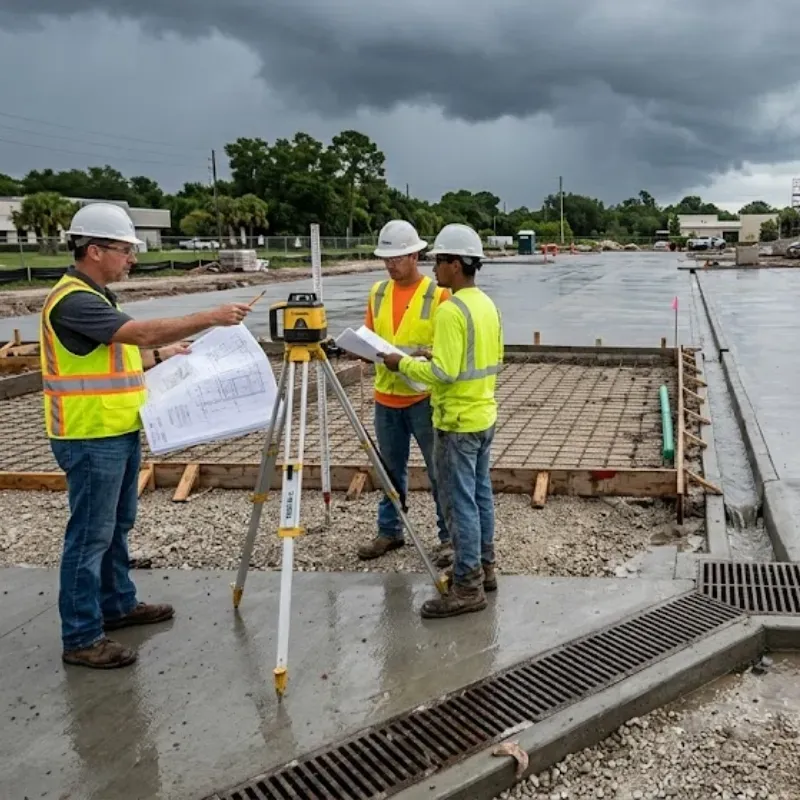
The most important thing a commercial property owner can do is bring drainage into the conversation at the planning stage — before design decisions lock in grades, drain locations, and subbase specifications. Retrofitting drainage solutions onto a completed concrete project is almost always more expensive and less effective than designing them in from the beginning. A parking lot that needs to have channel drains cut in after the fact, or a loading dock approach that needs to be broken out and regraded because water pools against the building, represents a preventable cost.
The second most important thing is working with a contractor who knows Baton Rouge’s specific conditions — the rainfall volumes, the soil behavior, the temperature range, and the regulatory requirements that affect commercial stormwater design in this jurisdiction. Generic drainage solutions designed for drier climates routinely underperform in Louisiana’s environment. Local experience with what actually holds up here is not a marketing point. It is a practical difference in outcomes.
If you are budgeting a commercial concrete project and want to understand how drainage design affects overall project cost, our breakdown of concrete pricing in Baton Rouge covers what drives cost in commercial concrete work and how to evaluate proposals in a way that accounts for long-term value, not just the upfront number.